Tuesday, March 13, 2012

Buried Treasure: Tales of the Green Beret

With the success of Robin Moore's war novel, Tales of the Green Beret, in the mid-1960s, the Chicago Tribune-New York News Syndicate decided to adapt the story as a comic strip about a member of the U.S. special forces serving in Vietnam. Originally offered to Neal Adams to draw, he suggested DC's foremost war artist, Joe Kubert, would be a better choice for the star-spangled feature. After a few try-out dailies, Moore's gritty story lines coupled with Kubert's equally piercing illustrations was a hit as the strip debuted in the early months of 1966. The story revolved around a tough talking cigar-chomping Lieutenant Ross and his special commando unit based in Vietnam. Not wanting to pull any punches, the creative team presented  the horrors of war in full force, burning villages, savage Vietcong guerrillas fire fights, and fleeing civilians were common place in this serious war strip. As the feature promoted the heroism of the American soldiers in Vietnam, the war at home was growing more unpopular with the U.S. public. In response to the change of the national mood, Kubert quit the strip in late 1967, and was replaced by John Celardo who continued on until its cancellation in 1969.


Tuesday, March 6, 2012

Marvel Spotlight: John Carter, Warlord of Mars

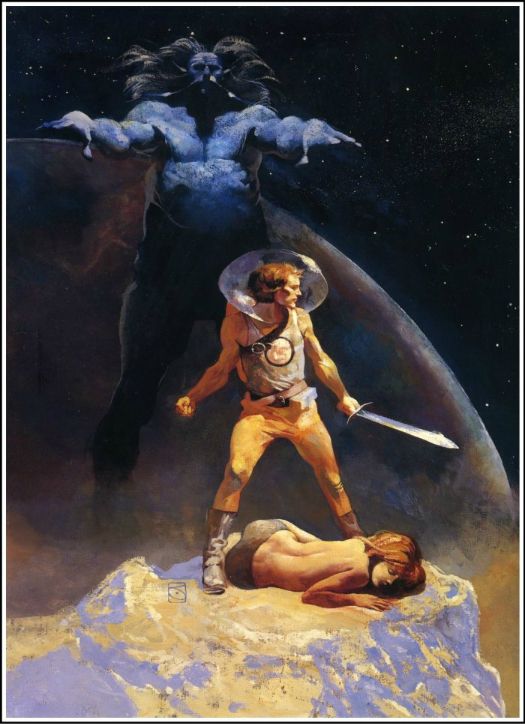
Written by Marv Wolfman and illustrated by Gil Kane, John Carter, Warlord of Mars debuted with Marvel Comics Group in 1977, based on the Barsoon series by Edgar Rice Burroughs. For a character who turns one hundred years old this year, John Carter unfortunately did not have much of a presence in the comics, with just a handful of issues from Dell Comics and DC before Marvel did its popular but short two year, thirty one issue run. Most of the series was set in a very narrow time frame based on the first novel, A Princess of Mars for the Marvel books. A classic story of science-fiction, Carter was a Virginian that served as a captain for the Confederacy during the Civil war who later stuck it rich prospecting in Arizona. While hiding from a band of Apaches in a cave, Carter has a strange out of body experience that transports him as an astral projection to the planet Mars. Leaving his shell of a body behind, he is re-embodied once again to his present form, thought now much stronger and more agile due to the lesser gravity of the "red" planet. A true adventurer at heart, John Carter soon becomes the premiere warlord fighting weird alien creatures and Martians alike while winning the heart of the lovely Martian Princess, Dejah Thoris of Helium. Based closely on the original source material, Wolfman's excellent scripts and Kane's dynamic pictures captured the swashbuckling excitement of Burroughs first hero with all the alien beauty and savage action of the novels. Recently licenced to other comic companies and with a big budget Disney movie to be released soon, John Carter should inspire a whole new legion of fans for the next century.


Thursday, March 1, 2012

Esteban Maroto's...Five For Infinity


One of Esteban Maroto's earliest strip adventures, Five for Infinity (Cinco por Infinito) debuted in September of 1967 loosely based on Jean Hougron's book, The Sign of the Dog. Initially a group effort from four of the top artists from Spain's Selecciones Illustradas (Maroto, Torrents, Suso, and Usero), Maroto took over the entire book with the fifth issue to finish out its successful twenty six wild episodes. The story revolves around five earthlings who work for Infinito, the last survivor of an extinct alien race, who with the members help keep order and unity in the universe. Each of the team have a special ability they use in concert on their numerous escapades together. Beautiful physician Aline has advanced mental powers; Sirio possessed great agility and speed; Orion has Atlas like strength; Altar vast intelligence; and Hidra was added as a lovely extra addition by accident. The real beauty of the feature is to follow the evolution of Maroto's work over the course of the stories. The artist's meticulous delicate style often makes one view a page taken as a whole over individual panels. Excellent draftsmanship coupled with a mastery of the human figure fused perfectly in these perfectly balanced compositions. Whether printed originally in stark black and white, or later stories with the use of vivid color, each were equally beautiful in their own right for the dynamic adventures of Cinco por Infinito.